


Page 68 - The Old Ratcliffian 2015 Magazine
P. 68
68 RATCLIFFE’S PAST

75 YEARS ON: RATCLIFFE COLLEGE
& THE BATTLE OF BRITAIN

This year, 2015, sees the 75th Anniversary of the Battle of Britain. We have a lot to be proud of at Ratcliffe College, not least those
young heroes who fought so hard on the front line to protect our country from hostile attack, one such being Paul Baillon (32). Here
at Ratcliffe, we also remember those who made an enormous contribution to victory on the ground, just a few yards away in adjacent
fields, at the Ratcliffe Aerodrome, which is now part of the Rosmini Centre.

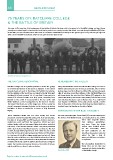
Ratcliffe Aerodrome during the war

THE RATCLIFFE AERODROME                                               REMEMBERING THE FALLEN

Ratcliffe College was in a pivotal position to watch the goings       Many Old Ratcliffians went on from Ratcliffe College to serve as
on of aerial movements in the country. Adjacent to the School         military personnel, but one of them, in particular, was to have a
grounds (and now part of them) was the Ratcliffe Aerodrome.           lasting impact on the College, his fellow ORs and current pupils
For the duration of the war, it was seconded to the Air Transport     alike. If you have read other editions of the Old Ratcliffian, you
Auxiliary (ATA) and renamed ‘No. 6 Ferry Pool’; it was part of a      will know about the role that Paul Baillon (32) played in the
network of around fourteen ATA ferry pools, stretching from           Second World War; how he was hit by enemy fire and had to bail
Hamble in the south to Lossiemouth in the far north, with             out, watching his plane crash in flames close to a small wood
White Waltham as the headquarters to the west of London.              near Upavon in Wiltshire. Very sadly, almost exactly a month
This meant that it was one of the major hubs in the country for       later, in November 1940, Paul was shot down by Helmut Wick in a
aircraft movement between factories and air bases, and, during        dogfight near the Needles on the Isle of Wight.
hostilities, it alone accounted for in excess of fifty thousand
flights.                                                              THE HISTORY OF THE BAILLON FAMILY

Those stationed within the ATA were mainly non-service                Historian and airline pilot, Steve Clark (79), has been delving into
personnel, who were tasked with taking over, from service pilots,     the history of the Baillon family, researching back as far as 1813,
the duty of ferrying RAF and RN warplanes between factories,
maintenance units and front-line squadrons. All this was done                                               when Louis Augustin Baillon,
without radios, with no instrument flying instruction, and all at                                           Paul Baillon’s grandfather,
the mercy of the British weather. Often, they were presented                                                was born. Steve has kindly
with a type of plane that they had never seen before. The first                                             written some detailed articles
recruits, though widely experienced, were either too old or unfit                                           for the Association, which
for active service, with some having served in the First World War.                                         we have published on the
So, the boys of Ratcliffe College would have had aircraft flying                                            Ratcliffian Association website;
directly overhead all day, every day. With the intensity of the air                                         please do take a look at
war during the summer and autumn of 1940, Ratcliffe would have                                              www.ratcliffianassociation.
certainly seen its fair share of Spitfires and Hurricanes during the                                        co.uk/news.
weeks that would soon become known as the Battle of Britain,
which would forever have its place in history.                                           The Association would like to
                                                                                         thank Steve for his time and
                                                                      Paul Baillon (32)  research into the historical links
                                                                                         of the Baillon family.

Register online at www.ratcliffianassociation.co.uk

