


Page 72 - Old Ratcliffian Magazine 2019
P. 72
RATCLIFFE’S PAST


        RATCLIFFE COLLEGE: THE START


        This year marks the 175th anniversary of the formal opening of the building at Ratcliffe, on
        the Feast of the Presentation of the Blessed Virgin Mary, when it was given the name of
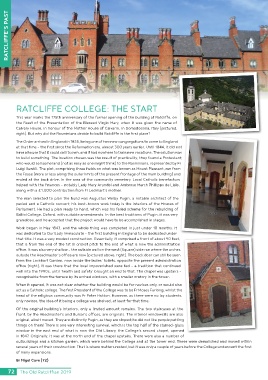
        Calvary House, in honour of the Mother House of Calvario, in Domodossola, Italy (pictured,
        right). But why did the Rosminians decide to build Ratcliffe in the fi rst place?
        The Order arrived in England in 1835, being one of two new congregations to come to England
        at that time – the fi rst since the Reformation era, almost 300 years earlier. Until 1844, it did not
        at that time – the fi rst since the Reformation era, almost 300 years earlier. Until 1844, it did not
        have a house that it could call its own, and it had nowhere to train new vocations. The solution was
        have a house that it could call its own, and it had nowhere to train new vocations. The solution was
        to build something. The location chosen was the result of practicality; they found a Protestant
        to build something. The location chosen was the result of practicality; they found a Protestant
        who would sell some land (not as easy as one might think) to the Rosminians, represented by Fr
        who would sell some land (not as easy as one might think) to the Rosminians, represented by Fr
        Luigi Gentili. The plot, comprising three fi elds on what was known as Mount Pleasant, ran from
        Luigi Gentili. The plot, comprising three fi elds on what was known as Mount Pleasant, ran from
        the Fosse (more or less along the outer limits of the present frontage of the main building) and
        the Fosse (more or less along the outer limits of the present frontage of the main building) and
        ended at the back drive, in the area of the community cemetery. Local Catholic benefactors
        ended at the back drive, in the area of the community cemetery. Local Catholic benefactors
        helped with the fi nances – notably Lady Mary Arundel and Ambrose March Phillipps de Lisle,
        along with a £1,000 contribution from Fr Lockhart’s mother.
        The man selected to plan the build was Augustus Welby Pugin, a notable architect of the
        period and a Catholic convert; his best-known work today is the interiors of the Houses of
        Parliament. He had a plan ready to hand, which was his failed scheme for the rebuilding of
        Balliol College, Oxford, with suitable amendments. In the best traditions of Pugin, it was very
        grandiose, and he accepted that the project would have to be accomplished in stages.
        Work began in May 1843, and the whole thing was completed in just under 18 months. It
        was dedicated to Our Lady Immaculate – the fi rst building in England to be dedicated under
        that title. It was a very modest construction. Essentially, it comprised a front of about 90 feet,
        that title. It was a very modest construction. Essentially, it comprised a front of about 90 feet,
        that is from the end of the 1st XI cricket pitch to the end of what is now the administration
        offi ce. It was also very shallow – the outside wall on the west (Square) side ran where the arches
        outside the Headmaster’s offi ce are now (pictured above, right). The back door can still be seen
        from the Lockhart Garden, now inside the ladies’ toilets, opposite the present administration
        offi ce (right). It was there that the local impoverished were fed – a tradition that continued
        well into the 1990s, until ‘health and safety’ brought an end to that. The chapel was upstairs –
        recognisable from the terrace by its arched windows, with a smaller oratory in the tower.
        When it opened, it was not clear whether the building would be for novices only, or would also
        act as a Catholic college. The fi rst President of the College was to be Fr Moses Furlong, whilst the
        head of the religious community was Fr Peter Hutton. However, as there were no lay students,
        only novices, the idea of it being a college was shelved, at least for that time.
        Of the original building’s interiors, only a limited amount remains. The two staircases at the
        Of the original building’s interiors, only a limited amount remains. The two staircases at the
        front, by the Headmaster’s and Bursar’s offi ces, are originals. The interior windowsills are also
        front, by the Headmaster’s and Bursar’s offi ces, are originals. The interior windowsills are also
        original, albeit moved. They are distinctly Pugin, as they are sloped; he did not like people putting
        original, albeit moved. They are distinctly Pugin, as they are sloped; he did not like people putting
        things on them! There is one very interesting survival, which is the top half of the stained-glass
        things on them! There is one very interesting survival, which is the top half of the stained-glass
        window in the east end of what is now the Old Library, the College’s second chapel, opened
        window in the east end of what is now the Old Library, the College’s second chapel, opened
        in 1847. Originally, it was at the north end of the chapel upstairs. There were also a number of
        outbuildings and a kitchen garden, which were behind the College and at the tower end. These were demolished and moved within
        several years of their construction. That is where matters rested, but it was only a couple of years before the College underwent the fi rst
        of many expansions.
        Br Nigel Cave (72)

     72   The Old Ratcliffi an 2019

